
Hosting Hardware: What a Farm Slot Changes in Your Payout
Moving machines into a hosted slot changes almost everything about running them and almost nothing about what they earn. At 1 PH/s the pool still credits 0.00001869 BTC an hour, reaching 0.00067291 BTC after 36 hours, or $56.99 at $84,692 per BTC. What a farm changes is the cost and reliability side: power, cooling, uptime and who answers when a board goes dark at midnight.

Key takeaways
- Hosting does not change output: 1 PH/s credits 0.00001869 BTC an hour and 0.00067291 BTC over 36 hours.
- A farm slot trades a capital cost for a recurring fee, usually priced against power and capacity rather than against coins.
- Uptime is the variable a host controls, and it shows up directly in the 36-hour total.
- Mining Farms lists hosting options, while Miner Hosting and Mining Companies cover the supply side of the same market.
What actually moves into the farm
Hosting means the machines live somewhere else. The miner keeps ownership, the pool account, the payout address and the coins; the host supplies the building, the power feed, the cooling and the hands that swap a failed fan. That division is worth stating plainly because it explains which numbers change. Hashrate, difficulty and the network total are untouched, so the coin output is untouched. Power cost, uptime and the shape of the invoice are not.
The practical consequence is that a hosted operation should be modelled as two ledgers. The first is the mining ledger, which is arithmetic on hashrate and difficulty. The second is the hosting ledger, which is a fee per machine or per kilowatt-hour plus whatever the contract says about repairs, minimum terms and notice. Confusing the two is how operators end up believing a hosting contract has changed their yield when it has only changed their costs.
The 36-hour curve does not know where the machine is
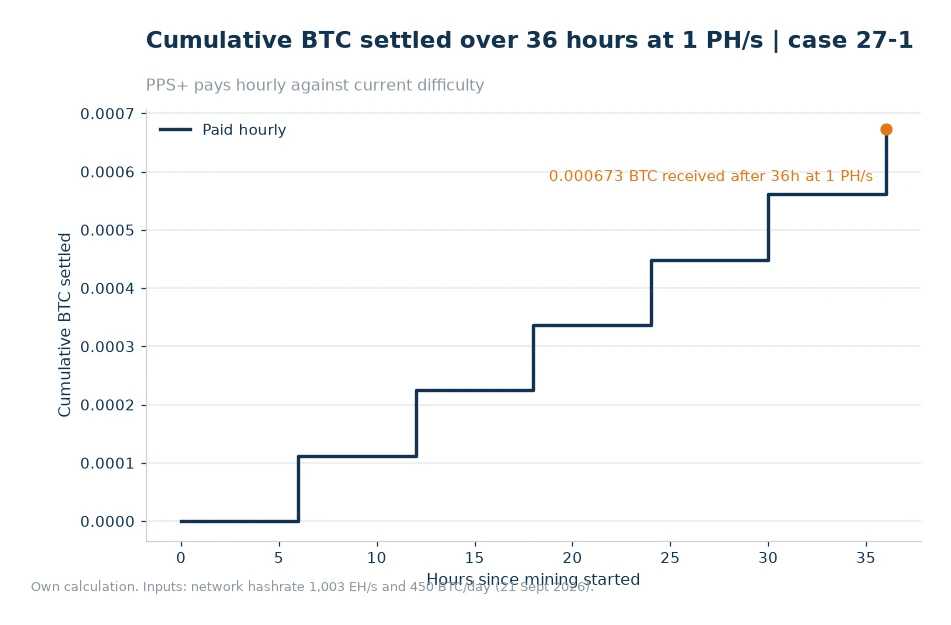
Under PPS+, the block-reward component settles hourly against current difficulty. That is true whether the hardware is in a garage or a hall with forty other racks. The chart below is the same staircase a home miner would see at the same hashrate, which is the point: the pool pays for shares, not for addresses.
The one place location enters is uptime. A hosted machine that loses power for two hours does not produce those two credits, and neither does a home machine. The difference is who notices and how fast. In a managed facility, monitoring is usually part of the service and a failed unit is often replaced or repaired without the owner travelling. At home, the owner is the monitoring.
Thirty-six hours, checkpoint by checkpoint
The table walks through the same run at six-hour intervals. Values come from the hourly credit of 0.00001869 BTC at 1 PH/s, the same rate used throughout.
| Hour | Cumulative BTC | USD at $84,692 | Credits received |
|---|---|---|---|
| 6 | 0.00011215 | $9.50 | 6 |
| 18 | 0.00033645 | $28.50 | 18 |
| 30 | 0.00056076 | $47.49 | 30 |
| 36 | 0.00067291 | $56.99 | 36 |
The credits column is the one to compare against a hosting invoice. If the contract is billed monthly per machine, divide by 30 to get a daily figure and hold it against the daily credit at your hashrate. At 1 PH/s that credit is $37.99 a day at $84,692, so a slot costing more than that before power would need a very different hashrate to make sense.
Worked example
Take 1 PH/s, the hashrate used in the chart, and follow the arithmetic end to end.
- Daily BTC per TH/s: 450 ÷ 1,003,000,000 = 0.00000044865.
- 1 PH/s is 1,000 TH/s: 1,000 × 0.00000044865 = 0.00044861 BTC a day.
- Hourly credit: 0.00044861 ÷ 24 = 0.00001869 BTC.
- Six hours: 6 × 0.00001869 = 0.00011215 BTC, or $9.50.
- Eighteen hours: 18 × 0.00001869 = 0.00033645 BTC, or $28.50.
- Thirty hours: 30 × 0.00001869 = 0.00056076 BTC, or $47.49.
- Thirty-six hours: 36 × 0.00001869 = 0.00067291 BTC, and 0.00067291 × 84,692 = $56.99.
- Two hours of downtime inside that window would remove 0.00003738 BTC, or $3.17 — small in absolute terms, but a recurring loss if it happens weekly.
What to ask before signing a hosting contract
Four questions decide most of the economics. What is the all-in rate per kilowatt-hour, including any cooling surcharge? What uptime is promised, and what happens to the fee when the machines are idle through no fault of yours? Who pays for repairs, and how long may a unit sit offline before it is replaced? What notice is required to leave, and does the hardware leave with you? A host that answers all four in writing is easier to compare with another than one that answers only the first.
Two further details are worth pinning down because they turn into money later. The first is the term: a contract that runs longer than the useful life of the machines transfers the risk of ageing hardware to the miner while the host keeps a fixed fee. The second is prepayment. Paying a year in advance is a loan to the host, and it should be priced as one — the discount for prepayment is only worth taking if it exceeds what the same money would earn elsewhere.
The ViaBTC Mining Farms listing is a starting point for the supply side, and the Miner Hosting directory covers providers that take third-party machines. Neither replaces a contract review. What they do is shorten the search and make the categories visible: full-service hosting, space-and-power only, and repair-included arrangements all appear under the same broad label.
Monitoring is the part you keep
Whichever arrangement you choose, the pool account stays yours. That means the hashrate curve, the credit history and the payout address remain under your control, and the host's dashboard is a second opinion rather than the only one. Check the two against each other for the first week; if the host reports 1 PH/s and the pool credits at the rate for 1 PH/s, the arrangement is working as described.
Set an alert for a drop below a threshold you would notice anyway. A machine that loses 20% of its hashrate is easy to miss in a monthly total and expensive to ignore for a quarter, particularly at a hosted rate that does not fall when output does. The alert is the cheapest insurance in the whole setup, and it costs nothing beyond the attention to configure it. Do the same for the daily credit: a missing day is easier to spot as a gap in a series than as a slightly smaller month.
Frequently asked questions
Does hosting change how much I earn from the pool?
No. At 1 PH/s the credit is 0.00001869 BTC an hour and 0.00067291 BTC over 36 hours wherever the hardware sits, because payout follows shares and difficulty rather than location.
What does a hosted slot usually cost?
Contracts are priced per machine or per kilowatt-hour and vary by region and service level, so compare the all-in rate against the daily credit at your hashrate, which is $37.99 at 1 PH/s and $84,692 per BTC.
Who owns the hardware in a hosted arrangement?
The miner does, which is why the pool account and payout address stay in the miner's name; the host supplies power, cooling, space and hands, and the contract should state how the hardware leaves.
Compare the invoice, not the brochure
Write the daily credit at your hashrate on one line and the all-in daily hosting cost on the next. If the first is larger by a margin you can live with through a difficulty change, the arrangement is workable. If not, no amount of facility quality changes the arithmetic. The Profit Calculator will produce the first line in dollars at current difficulty, and the second line is a question for the host.
Sources: the ViaBTC farms, companies and fee pages for hosting categories and the listed 4%[1]. Chain data read 21 Sept 2026: network hashrate 1,003 EH/s, difficulty 132.76 T, 3.125 BTC per block, 144 blocks a day, BTC $84,692. Published 22 Oct 2026; credit figures are arithmetic on those inputs and assume continuous uptime.