
Who Signs Off at Each Checkpoint: OEM and ODM Quality Splits
The difference between OEM and ODM is usually explained as who develops the scent. On a seasonal run, the more consequential difference is who owns each quality checkpoint. In OEM, the brand specifies and the factory executes, so the evidence trail runs between two parties. In ODM, the factory both develops and produces, so it holds more of the record and the brand's job becomes verification rather than control. Getting the split wrong shows up at release, not at the brief.
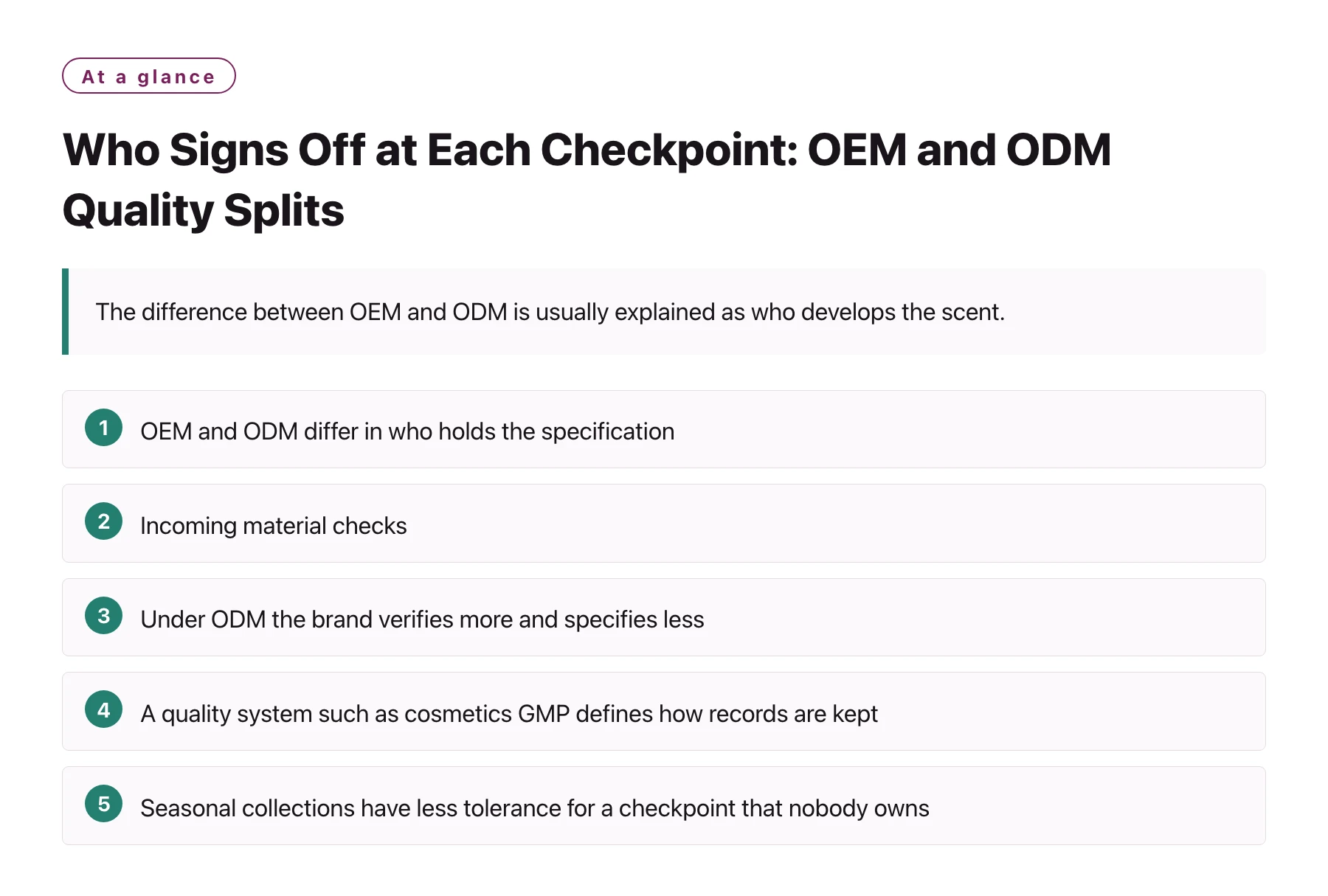
Key takeawaysOEM and ODM differ in who holds the specification, and therefore in who can prove that a batch matched it. · Incoming material checks, compounding, filling and packing are usually factory-executed in both modes, but the specification they are checked against comes from different parties. · Under ODM the brand verifies more and specifies less, which makes the release comparison against a retained reference the central control. · A quality system such as cosmetics GMP defines how records are kept, not who owns the decisions, so it does not remove the need to agree the split [1]. · Seasonal collections have less tolerance for a checkpoint that nobody owns, because the window does not allow a re-run.
Quality control in fragrance production is a chain of checkpoints, and a chain is only as strong as the assignment of each link. The two commercial models distribute those links differently, and the seasonal calendar makes the difference visible.
This is written from a quality perspective, for a brand that has chosen a model and now has to define who checks what. It assumes the product is already specified and the item list is fixed; the question is how the checks are owned.
The matrix below is deliberately plain. It is a starting point for a written agreement about responsibility, not a substitute for one.
Why the split changes the checkpoints
Under OEM, the brand brings a specification — often a formula developed elsewhere or developed jointly — and the factory produces against it. The factory owns process control and records; the brand owns the standard and the release decision. The evidence trail is a dialogue across two organisations.
Under ODM, the factory develops the scent and produces it. The brand approves a direction and a specification, then verifies that production matched it. More of the record sits inside one organisation, which is efficient and also concentrates risk: if the internal record is thin, the brand has little to compare against.
Both models can produce consistent seasonal ranges. What differs is where the brand has to place its attention, and that is what the checkpoint matrix is for. Fragrance houses and suppliers publish extensively on material compliance and testing because those are the points where the two modes most often blur [2]. Manufacturers that publicly describe working in both modes, such as Xuelei fragrance OEM and ODM manufacturer, are a reasonable place to ask how the split is usually drawn in practice, and how deviations and releases are handled.
Specification ownership is the dividing line
Ask a single question to locate the split: who wrote the document that the batch is checked against? In OEM it is usually the brand; in ODM it is usually the factory. Everything else, including who runs the checks, follows from that answer.
Records are not the same as decisions
A certified quality system describes how records are produced and retained, and it makes a factory auditable. It does not decide who may change a specification, who signs a deviation, or who holds the reference sample. Those are commercial terms and should be written down. A partner's published service list — for instance the scope covered by their OEM/ODM manufacturing services — is a reasonable starting point for that conversation.
A checkpoint matrix for the two modes
| Checkpoint | Under OEM | Under ODM | Brand's role |
|---|---|---|---|
| Incoming materials | Factory checks against the agreed specification | Factory checks against its own specification | Ask which specification applies; request the record for the batch |
| Compounding and dosage | Factory follows the brand's formula and dosage | Factory follows its own formula, approved by the brand | Confirm the approved version is the one in production |
| In-process checks | Factory owns them; the brand may audit | Factory owns them | Agree which checks are reported and at what frequency; cosmetics testing is frequently subcontracted to external laboratories [3] |
| Filling and assembly | Factory owns the line; the brand owns the standard | Factory owns both | Check weight and fill records against the specification |
| Decoration and labelling | Brand supplies artwork; factory applies and inspects | Factory may supply artwork; the brand approves it | Approve artwork and confirm the declaration list is current |
| Release against reference | Comparison is a joint act between brand and factory | Factory compares; the brand verifies with its own retained reference | Hold your own reference and use it at release |
| Deviation and rework | Brand decides whether a deviation is acceptable | Factory proposes; the brand decides | Agree in advance who may approve a deviation, and in what form |
Two rows carry most of the risk. Release against reference is the point where a drifting dosage is caught, and deviation handling is the point where a decision made in a hurry becomes a permanent change to a seasonal range. Under ODM the brand cannot outsource verification of the reference comparison, because that is the only control it still holds. Under OEM the brand cannot outsource the standard, because the factory has nothing to check against if the specification is vague.
Setting up the checkpoints before the run
The matrix only works if it is agreed before production, not reconstructed afterwards. Two documents do most of the work: a one-page split that names each checkpoint and its owner, and a clear statement of the specification version in force. Everything else is a rehearsal of decisions that have already been made.
Write the split down, then name the version
List each checkpoint with who executes it, who approves it and what record it produces. Ambiguity here is discovered at release, when there is no time to resolve it. In the same document, identify the exact specification version the batch will be checked against, and confirm the factory holds that version rather than an earlier one.
Agree the deviation route, the reference and the rehearsal
Decide who may accept a deviation, what evidence is required and whether the brand must approve before the batch moves on. Whatever the model, the brand should retain its own sealed reference sample, because it is the only independent standard available at release. Then run the comparison procedure once on a batch before the seasonal run, so the people involved have done it once without a deadline attached.
The most expensive misunderstanding in OEM and ODM work is the assumption that a certified factory has absorbed the brand's responsibility. It has not. A quality system makes the factory's own process auditable; it does not make the brand's specification complete, it does not appoint an approval owner, and it does not retain a reference on the brand's behalf. Those three things stay with the brand in both models, and a seasonal range is the worst place to discover it, because the window will not reopen for a corrected batch.
Release is the checkpoint that matters most
Every checkpoint before release is a process control, and process controls reduce the probability of a problem. Release is different: it is the moment the batch is compared against the approved standard, and it is the last opportunity to catch a difference before the product is packed and shipped.
Under ODM the comparison is often performed by the factory, with the brand reviewing a record. That is workable if the brand holds its own reference and performs its own check on arrival. Under OEM the comparison is naturally a shared act, and the brand should expect to see the retained sample alongside the batch sample rather than a written assurance.
The regulatory context is relevant here, because the party responsible for a product on the market is defined by the market rather than by the manufacturing model. In the European framework, the responsible person is a defined role that sits with a named entity, and that role does not transfer to a factory just because the factory developed the scent [4]. Understanding where that responsibility sits is part of defining the quality split.
A manufacturer that works in both modes is worth asking how the split is usually drawn in practice, and how deviations and releases are handled. The same questions are worth asking of any partner, and the answers tend to look similar across experienced factories; what differs is how clearly they are written down.
For a broader view of where quality is won and lost once volume rises, the checkpoints described in quality control in luxury fragrance production are a useful companion to this matrix. Where a partner takes on the development work as well, as an an ODM partner for fragrance brands typically does, the brand's verification role becomes more important rather than less. And whether the model is OEM or ODM, the manufacturing scope itself — the set of steps the factory actually performs — is what determines how many hand-offs sit between the brand and the finished bottle.
Sources
- ISO 22716 — Cosmetics Good Manufacturing Practices
- IFRA Standards Library (International Fragrance Association) —— The IFRA Standards Library lists the restrictions the fragrance industry applies to individual fragrance ingredients, based on safety assessments; it is the reference point for compliant fragrance formulation.
- SGS: Cosmetics, Personal Care & Household Testing —— Testing, inspection and certification services for cosmetics and personal care, including microbiological, stability and safety testing aligned with cosmetics GMP.
- European Commission: Cosmetics in the EU —— The European Commission's overview of EU cosmetics rules, including the responsible person, product information file and safety report requirements.
Frequently asked questions
In ODM, does the factory take over quality control completely?
It executes most checkpoints and holds much of the record, but the brand still owns verification. Retain your own reference sample, confirm which specification version is in force, and check the batch against your reference rather than relying on a written assurance.
Does a GMP certificate mean the brand's quality obligations are covered?
No. A cosmetics GMP system makes a factory's processes auditable and its records traceable, but it does not supply the brand's specification, appoint an approval owner or retain the brand's reference. Those remain brand responsibilities in both OEM and ODM.
Who should approve a deviation during production?
Agree this before the run. A common arrangement is that the factory proposes a deviation with evidence and the brand approves it in writing before the batch proceeds. Deciding case by case under time pressure is how unplanned changes enter a seasonal range.
What should the brand check at release if the factory runs the comparison?
The batch sample against the brand's own retained reference, plus the fill and weight records and the label copy against the current declaration list. The comparison is a physical act, not a document review, even when the factory has already performed it.
Is OEM or ODM better for quality on a seasonal collection?
Neither is inherently better. OEM gives the brand more control over the specification and more shared checkpoints; ODM concentrates execution and reduces hand-offs while shifting the brand's role toward verification. The model should match how much specification work the brand wants to own.
Превратите трафик в выручку
Бесплатный аудит из 174 контрольных точек — пришлём список из 5–7 действий, которые изменят конверсию. Без отчёта на 40 страниц.
Получить бесплатный аудит Как мы работаем